Venezuela Politics: Machado Returns Home
The opposition leader arrived in Caracas following a cross-country journey, marking a shift in the nation's political dynamics since the removal of former President Nicolás Maduro.
By Sabrina Mitchell ·
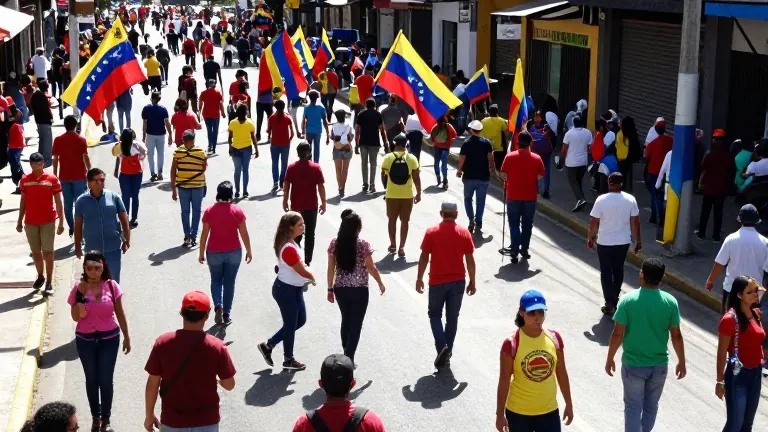
Maria Corina Machado is back in Venezuela.
The opposition leader drove from the western state of Lara to the capital, Caracas, on a route lined with cheering crowds. This journey stands in sharp contrast to her exit ten months earlier in December, when she slipped out of the country in the dark to accept the Nobel Peace Prize in Oslo.
Machado had attempted to return on at least eight occasions previously. The Venezuelan government blocked her entry, and the Trump administration insisted the timing was not right. Now, the US has given its approval. She arrives in a country where her former political rival, Nicolás Maduro, no longer holds power.
US troops forcibly removed Maduro on January 3. He was taken to New York, where he faces charges of drug trafficking, weapons offenses, and torture, all of which he has denied. He was replaced by his former vice president, Delcy Rodríguez. Under new leadership, the relationship between Washington and Caracas has shifted from years of hostility to a more cooperative stance.
The change in administration has altered the political landscape for Machado. She leaves exile as Washington's preferred alternative to Maduro but returns to find the Trump administration satisfied with Rodríguez. The US recently signed a major oil deal with Venezuela, granting a 100-year concession for 65 billion barrels of crude oil. The agreement involved a private company, North American Blue Energy Partners, led by Alejandro Betancourt.
Machado has criticized this deal. She directed her critique at the Rodríguez government and Betancourt, while maintaining a careful distance from President Donald Trump. Trump has praised Rodríguez, calling her a terrific person, despite previously labeling her administration as narco-communists. This dynamic creates a complex position for Machado, who seeks Trump's trust to move forward.
Supporters in Caracas greeted her return with visible enthusiasm. Gregory Noriega, a 20-year-old wearing a Vente Venezuela sweatshirt, called her the indisputable leader of the country. Hilary, an 18-year-old, described the return as a step forward in the electoral process. Manuel, a friend of Hilary, noted that the country is behind Machado to show that Venezuela is no longer afraid.
Political analyst Beningno Alarcon views this return as the most important political event since January 3. He argues that Machado's presence on the ground strengthens the opposition, which previously existed only in exile. Alarcon points to data from think tanks Polis and Nexo, which found that street protests in the first nine months of this year tripled compared to all of 2025. Reports indicate that repression of these protests has also dropped by more than half.
US Secretary of State Marco Rubio stated that Machado's safe return was a direct result of US-supported reconciliation talks between the government and the opposition. Machado still faces charges of treason and conspiracy of insurrection in Venezuela, which her supporters dismiss as politically motivated. Rodríguez, who needs a good relationship with Washington to avoid a similar fate to Maduro, indicated she might be prepared to hold talks with Machado.
Rodríguez publicly called the return a show. State television ignored the cross-country event, which was livestreamed by Machado's supporters. Trump has made it clear that Washington expects full submission from Rodríguez on energy issues. Some reports suggest that Secretary Rubio dictates major decision-making to the interim president via regular WhatsApp calls. Young supporters in Caracas say their fears of demanding change are vanishing as this political transition becomes irreversible.
Source: BBC News